
Retatrutide vs Tirzepatide: Research & Scientific Comparison
Retatrutide vs Tirzepatide has become an important comparison within incretin and metabolic research. Both molecules interact with hormone receptors involved in metabolic signalling, but their receptor profiles are not identical.
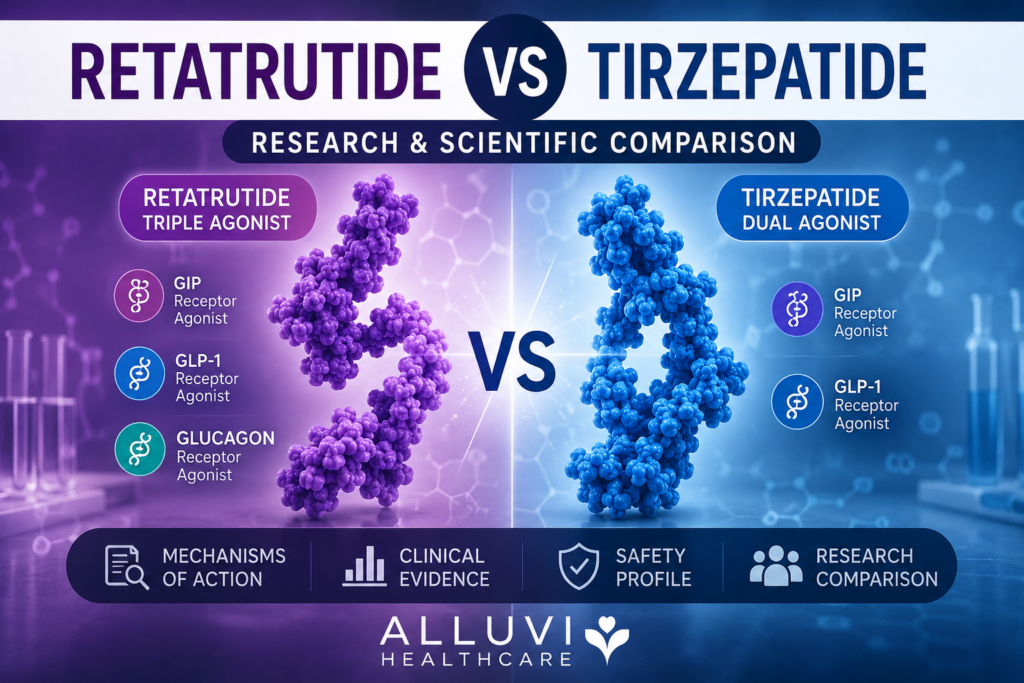
Tirzepatide is a dual GIP and GLP-1 receptor agonist, while Retatrutide is an investigational GIP, GLP-1 and glucagon receptor triple agonist.
That additional glucagon-receptor activity represents the fundamental molecular distinction between the two.
However, simply counting receptor targets does not establish which compound is “better.” Retatrutide and Tirzepatide have different development and regulatory histories, and results from separate clinical trials cannot automatically be interpreted as head-to-head evidence.
This guide compares Retatrutide and Tirzepatide from a scientific perspective, examining receptor pharmacology, molecular design, clinical evidence and the research questions surrounding dual versus triple agonism.
Retatrutide vs Tirzepatide at a Glance
| Characteristic | Retatrutide | Tirzepatide |
|---|---|---|
| GIP receptor activity | Yes | Yes |
| GLP-1 receptor activity | Yes | Yes |
| Glucagon receptor activity | Yes | No |
| Receptor profile | Triple agonist | Dual agonist |
| Development identifier | LY3437943 | LY3298176 |
| Scientific category | GIP/GLP-1/glucagon agonist | GIP/GLP-1 agonist |
| Development context | Investigational | Established clinical-development and authorized-medicine context in relevant jurisdictions |
The most important scientific difference is therefore straightforward: Retatrutide adds glucagon receptor agonism to the GIP/GLP-1 combination found in Tirzepatide.
What Is Retatrutide?
Retatrutide, also known as LY3437943, is an investigational molecule designed to activate three receptor systems:
glucose-dependent insulinotropic polypeptide (GIP) receptors;
glucagon-like peptide-1 (GLP-1) receptors; and
glucagon receptors.
This combination has led researchers to describe Retatrutide as a triple hormone receptor agonist.
Retatrutide research is particularly relevant to the developing field of multi-agonist metabolic science, where researchers investigate whether coordinating several receptor pathways within one molecule can produce biological effects different from those observed with single- or dual-receptor agonists.
What Is Tirzepatide?
Tirzepatide is a molecule with agonist activity at two receptor systems:
GIP receptors; and
GLP-1 receptors.
For this reason, Tirzepatide is commonly described as a dual GIP/GLP-1 receptor agonist.
Tirzepatide has a more established clinical and regulatory history than Retatrutide and has been extensively investigated across metabolic research programmes.
The distinction in development status is important when comparing the molecules. Research involving an investigational molecule should not be presented as though it has the same regulatory status as an authorized medicine.
Retatrutide Triple Agonist vs Tirzepatide Dual Agonist
The most significant difference between Retatrutide and Tirzepatide concerns receptor pharmacology.
Tirzepatide combines GIP and GLP-1 receptor agonism.
Retatrutide combines those same broad receptor families with glucagon receptor agonism.
This creates two different multi-agonist strategies.
Tirzepatide: Dual Agonism
The Tirzepatide approach combines two incretin-related receptor pathways.
GIP and GLP-1 are both nutrient-responsive hormones, although their physiological signalling characteristics are not identical.
Combining these pathways within a single molecule represents an important development beyond traditional single-receptor GLP-1 agonism.
Retatrutide: Triple Agonism
Retatrutide expands the multi-agonist concept by incorporating glucagon receptor agonism alongside GIP and GLP-1 receptor activity.
The glucagon receptor component has generated substantial research interest because glucagon signalling participates in metabolic processes distinct from the incretin pathways.
Researchers are therefore investigating whether coordinated GIP, GLP-1 and glucagon receptor activity produces a pharmacological profile that differs meaningfully from dual agonism.
Why Does the Glucagon Receptor Matter?
The glucagon receptor is central to understanding the scientific difference in a Tirzepatide vs Retatrutide comparison.
GLP-1 and GIP receptor signalling form the shared foundation of both molecules.
Glucagon receptor agonism is the additional component associated with Retatrutide.
Glucagon participates in metabolic regulation, including pathways associated with glucose and energy metabolism.
Researchers have consequently investigated whether incorporating glucagon receptor activity into multi-agonist molecules could influence energy expenditure, substrate utilization and other metabolic processes.
These hypotheses require experimental evidence. The presence of glucagon receptor activity alone should not be interpreted as proof that Retatrutide is superior to Tirzepatide.
Comparing Their Mechanisms
The receptor-level comparison can be summarized as follows.
Shared GIP Activity
Both Retatrutide and Tirzepatide incorporate GIP receptor agonism.
GIP is an incretin hormone associated with nutrient-responsive signalling.
Research involving GIP has expanded significantly as scientists have investigated its potential interaction with GLP-1 receptor pathways.
Shared GLP-1 Activity
Both molecules also incorporate GLP-1 receptor agonism.
GLP-1 receptor research has become one of the most extensively studied areas of modern metabolic pharmacology.
The fact that both molecules involve GLP-1 signalling provides a shared pharmacological component, but their complete receptor profiles remain different.
Retatrutide’s Additional Glucagon Activity
Retatrutide adds glucagon receptor agonism.
This creates its defining triple-receptor profile and is the principal molecular feature separating Retatrutide from Tirzepatide.
Retatrutide Clinical Research
Retatrutide has undergone substantial clinical investigation.
A major randomized Phase 2 study investigated Retatrutide in adults with obesity or overweight with at least one weight-related condition.
The research evaluated several dose groups against placebo and examined outcomes over a 48-week treatment period.
The findings generated significant scientific interest and helped support progression into a larger Phase 3 clinical programme.
Retatrutide research has subsequently expanded across several metabolic and obesity-associated research areas.
Tirzepatide Clinical Research
Tirzepatide has a larger and more mature clinical evidence base.
Major clinical programmes have investigated the molecule across metabolic conditions and obesity.
Research has examined outcomes including body-weight changes, metabolic markers and other clinically relevant endpoints.
Unlike Retatrutide, Tirzepatide has progressed beyond investigational-only status into authorized pharmaceutical use for specific indications in relevant jurisdictions.
This regulatory difference must remain clear when comparing the two compounds.
Can Retatrutide and Tirzepatide Trial Results Be Compared Directly?
This is one of the most important questions in a responsible Retatrutide vs Tirzepatide comparison.
Results from separate clinical trials should not automatically be treated as though the compounds were tested head-to-head.
Different studies may involve different:
participant populations;
inclusion and exclusion criteria;
study durations;
statistical methods;
endpoints;
protocols;
comparator groups; and
clinical environments.
For example, observing one percentage in a Retatrutide study and another percentage in an unrelated Tirzepatide study does not establish that one molecule would produce a superior result if both were tested under identical conditions.
A scientifically stronger comparison requires randomized head-to-head evidence.
TRIUMPH-5: Direct Retatrutide vs Tirzepatide Research
A particularly important development is the TRIUMPH-5 Phase 3 study.
Unlike comparisons made by placing results from unrelated studies side by side, TRIUMPH-5 was designed specifically to evaluate Retatrutide compared with Tirzepatide in adults with obesity.
This makes the trial particularly relevant to the scientific question surrounding Tirzepatide vs Retatrutide.
The study has an enrollment goal of approximately 800 participants and is designed to assess efficacy and safety.
Until complete results are available and appropriately evaluated, researchers should avoid claiming that the trial proves one compound superior to the other.
The existence of a genuine head-to-head trial is nevertheless important because it can provide much stronger comparative evidence than indirect cross-trial comparisons.
What Did Retatrutide Phase 2 Research Find?
Published Phase 2 research involving 338 adults reported substantial reductions in body weight across several Retatrutide groups during the 48-week treatment period.
The highest investigated group in the published trial had a mean reduction of approximately 24% at week 48.
Gastrointestinal events were among the most commonly reported adverse events, and investigators also reported dose-dependent changes in heart rate.
These findings helped establish the scientific rationale for larger Phase 3 investigation.
They should not, however, be interpreted as a direct comparison with Tirzepatide because Tirzepatide was not the active comparator in that Phase 2 trial.
What Has Tirzepatide Research Found?
Tirzepatide has been investigated in major clinical programmes including SURPASS and SURMOUNT.
The SURMOUNT-1 trial, for example, investigated Tirzepatide in adults with obesity or overweight without diabetes and demonstrated substantial changes in body weight during the study.
Subsequent research has expanded the evidence base considerably.
Tirzepatide has also been evaluated directly against other molecules in controlled research, demonstrating why head-to-head trials provide stronger comparative information than simply comparing percentages across unrelated studies.
Does Triple Agonism Mean Retatrutide Is Better?
No conclusion should be drawn simply from the words “triple agonist.”
A molecule interacting with three receptor systems is not automatically superior to one interacting with two.
Pharmacology is more complex than receptor counting.
Relevant factors can include:
receptor potency;
receptor balance;
pharmacokinetics;
molecular structure;
exposure;
tolerability;
safety;
study population;
treatment duration; and
the clinical outcome being investigated.
The Retatrutide triple-agonist architecture is scientifically interesting precisely because researchers need evidence to determine what the additional glucagon receptor component contributes.
Retatrutide vs Tirzepatide: Research Evidence
The evidence surrounding the two molecules is currently asymmetric.
Tirzepatide has a more mature clinical and regulatory evidence base.
Retatrutide has rapidly progressing clinical research, including major Phase 3 investigation, but remains investigational.
Researchers should therefore avoid treating the two evidence bases as equivalent merely because the molecules share GIP and GLP-1 receptor activity.
The scientific comparison will become more informative as additional Retatrutide Phase 3 data and direct comparative evidence become available.
Safety Research
Safety is another area where simplistic comparisons should be avoided.
Both molecules have been evaluated for adverse events within clinical research programmes.
Gastrointestinal adverse events have been reported in studies involving incretin-based multi-agonist compounds.
However, adverse-event rates from different trials cannot automatically be compared without considering differences in study design, populations, exposure and methodology.
A valid safety comparison requires appropriately designed comparative evidence.
Research Status vs Regulatory Status
Another major difference between Retatrutide and Tirzepatide concerns regulatory context.
Retatrutide remains an investigational molecule undergoing clinical development.
Tirzepatide has obtained regulatory authorization for specific medical indications in relevant jurisdictions.
This distinction means information about the two compounds should be presented differently.
Clinical development of Retatrutide does not make laboratory Retatrutide products authorized medicines.
Likewise, research materials carrying a compound name should not be assumed to have the same manufacturing controls, specifications or regulatory status as pharmaceutical products used in regulated clinical programmes.
Laboratory Research Materials and Clinical Medicines Are Different
Researchers should distinguish between:
an investigational compound studied in regulated clinical trials;
an authorized pharmaceutical medicine; and
a laboratory research material sold for scientific research.
These categories are not interchangeable.
A laboratory material labelled Retatrutide should not automatically be considered equivalent to the Retatrutide material manufactured for regulated clinical research.
Similarly, a laboratory material carrying the Tirzepatide name should not automatically be considered equivalent to an authorized pharmaceutical product.
This distinction is important when interpreting published research.
Retatrutide and Tirzepatide Research at Alluvi Healthcare
Alluvi Healthcare organizes educational resources separately from individual laboratory research-product pages.
Researchers seeking deeper information about triple agonism can explore the Retatrutide Research: Triple Agonist Science & Clinical Trials guide.
Researchers evaluating available laboratory research materials can separately explore the Retatrutide research products collection and relevant individual product specifications.
This structure helps distinguish scientific education from product-specific information.
Frequently Asked Questions
1. What is the main difference between Retatrutide and Tirzepatide?
Tirzepatide acts at GIP and GLP-1 receptors, making it a dual agonist. Retatrutide incorporates GIP, GLP-1 and glucagon receptor agonism, giving it a triple-receptor profile.
2. Is Retatrutide a triple agonist?
Yes. Retatrutide is being investigated as a GIP, GLP-1 and glucagon receptor agonist.
3. Is Tirzepatide a triple agonist?
No. Tirzepatide is a dual GIP and GLP-1 receptor agonist.
4. Is Retatrutide better than Tirzepatide?
That conclusion should not be made simply from separate trial results or the number of receptor targets. Direct comparative research is more appropriate for evaluating relative efficacy and safety.
5. Is there a Retatrutide vs Tirzepatide clinical trial?
Yes. The Phase 3 TRIUMPH-5 study was designed to compare Retatrutide directly with Tirzepatide in adults with obesity.
6. Are Retatrutide and Tirzepatide the same compound?
No. They are different molecules with different receptor profiles and different regulatory/development contexts.
Educational Resources
Researchers investigating Retatrutide and Tirzepatide should prioritize peer-reviewed publications, registered clinical trials and authoritative developer or regulatory information.
The published Retatrutide Phase 2 study provides important evidence about the triple agonist.
Published Tirzepatide research provides evidence surrounding dual GIP/GLP-1 agonism.
The TRIUMPH-5 clinical trial is particularly important for future comparisons because it directly evaluates Retatrutide against Tirzepatide rather than relying on indirect comparisons between unrelated studies.
As new results become available, researchers should distinguish preliminary company announcements from complete peer-reviewed publications.
Conclusion
The Retatrutide vs Tirzepatide comparison illustrates the continuing evolution of multi-receptor metabolic research.
Both molecules incorporate GIP and GLP-1 receptor agonism, but Retatrutide adds glucagon receptor activity, creating its distinctive triple-agonist profile.
Tirzepatide currently has a more mature clinical and regulatory evidence base, while Retatrutide remains investigational and continues through an extensive clinical-development programme.
Most importantly, receptor count alone cannot determine which molecule is superior.
Direct comparative research—particularly the Phase 3 TRIUMPH-5 study—is more scientifically meaningful than comparing headline percentages from separate clinical trials.
As additional head-to-head and Phase 3 evidence becomes available, researchers will be better positioned to understand how triple GIP/GLP-1/glucagon agonism compares with dual GIP/GLP-1 agonism.