
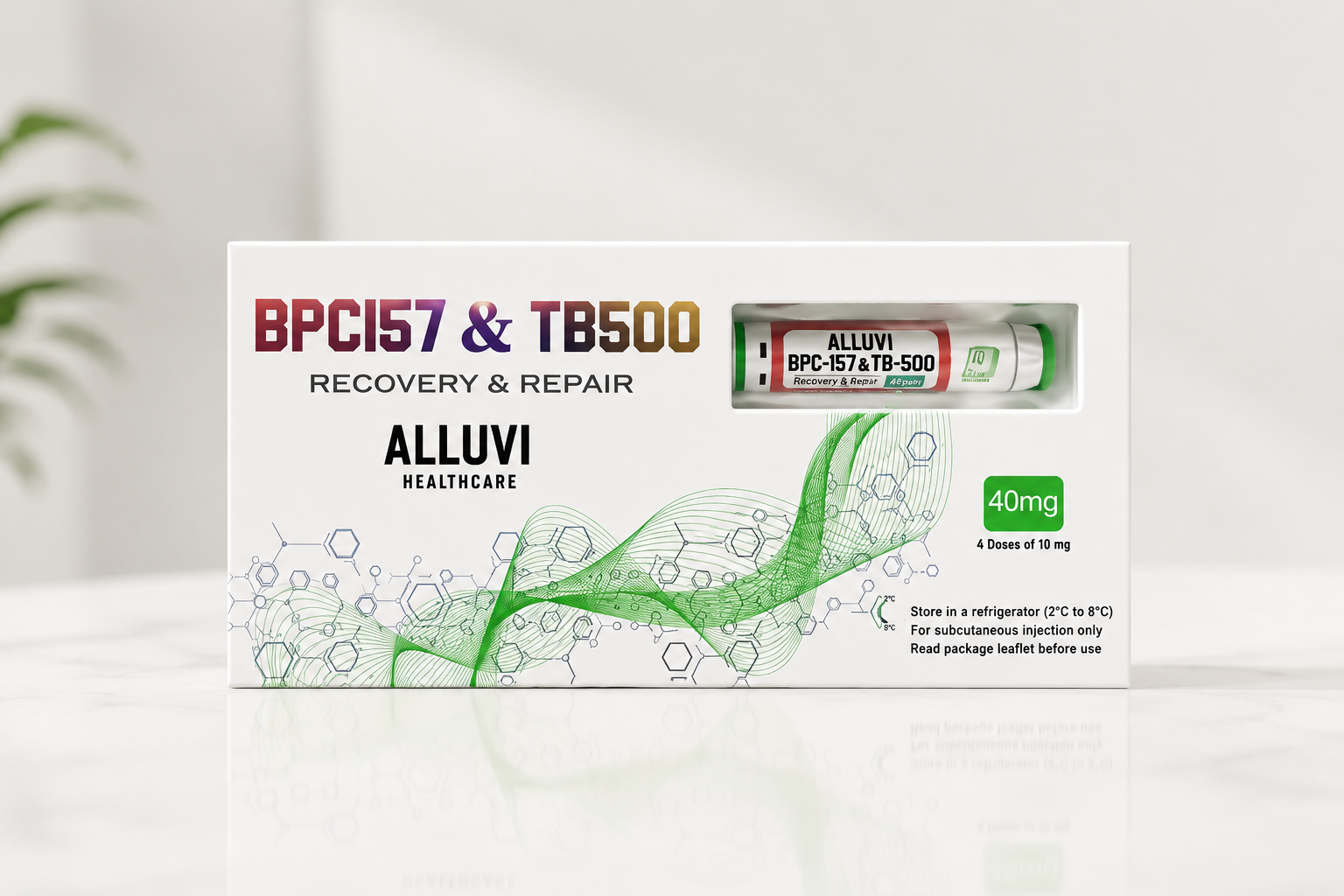
Alluvi BPC-157 TB-500 40mg UK
BPC-157 TB-500 40mg UK from Alluvi Healthcare UK is a specialist combined research catalogue product intended for controlled laboratory investigation, analytical research and scientific education.
The product brings together two research peptides that have attracted significant scientific interest: BPC-157 and TB-500.
The BPC-157 TB-500 40mg UK presentation provides laboratories with a clearly identified combined 40mg catalogue product that can be recorded alongside its SKU, supplier information, physical packaging and genuine product-specific documentation where supplied.
The stated 40mg refers to the total catalogue presentation. The exact proportion contributed by each research component should not be assumed unless it is confirmed by genuine product-specific documentation.
This page provides detailed information about the catalogue product, the scientific background of BPC-157 and TB-500, peptide analytical research, product traceability, laboratory documentation and responsible research practices.
Alluvi Healthcare UK presents this material specifically for research and development purposes.
It is not presented as an authorised medicine, therapeutic product or product intended for personal administration.
Researchers interested in related catalogue products can explore the BPC-157 & TB-500 Research collection or browse the wider Research Peptides UK catalogue.
BPC-157 TB-500 40mg UK Product Information
| Product Detail | Information |
|---|---|
| Product | Alluvi BPC-157 TB-500 40mg UK |
| Classification | Research & Development Only |
| Stated Total Quantity | 40mg |
| SKU | 2017175020168 |
| Research Area | BPC-157 and TB-500 peptide research |
| Product Type | Combined research catalogue product |
| Catalogue Market | United Kingdom |
| Intended Context | Laboratory research and scientific education |
| Human Administration | Not intended for human administration |
| Veterinary Administration | Not intended for veterinary administration |
The stated 40mg quantity forms part of the catalogue identity of BPC-157 TB-500 40mg UK.
It should not be interpreted as a human dose, administration recommendation, injection instruction or treatment protocol.
Researchers should confirm the exact physical product received against the label, SKU, packaging and genuine product documentation before beginning laboratory work.
What Is BPC-157?
BPC-157 is a synthetic peptide that has attracted research interest across several preclinical areas.
Scientific literature has investigated BPC-157 in relation to experimental models involving tissue biology, gastrointestinal research, inflammatory signalling, vascular responses and musculoskeletal research.
For laboratories studying BPC-157 TB-500 40mg UK, the BPC-157 component provides one area of scientific interest within the combined research product.
A recent systematic review indexed by PubMed examined the existing literature surrounding BPC-157 and concluded that much of the published evidence remains preclinical, with limited rigorous human data.
Researchers can review the BPC-157 systematic review on PubMed for independent scientific context.
This is important because findings from animal or laboratory studies should not automatically be converted into claims about human outcomes.
Scientific evidence and commercial product claims should remain clearly separated.
Understanding BPC-157 Research
BPC-157 has been investigated in a variety of experimental models.
Areas discussed in scientific literature include:
- peptide signalling;
- tissue-response models;
- experimental vascular research;
- gastrointestinal research;
- musculoskeletal models;
- inflammatory pathways;
- cellular signalling;
- preclinical recovery models.
The existence of research in these areas does not mean that BPC-157 TB-500 40mg UK is proven to produce a specific biological outcome.
Research findings apply to the experimental conditions under which they were generated.
The quality of any commercial research material must also be assessed separately from the published literature.
What Is TB-500?
TB-500 is a synthetic peptide associated with the active region of thymosin beta-4.
Research literature frequently discusses thymosin beta-4 because of its biological roles in actin regulation, cell migration and several experimental tissue-response pathways.
TB-500 should not automatically be treated as identical to full-length thymosin beta-4.
The World Anti-Doping Agency has described TB-500 as the N-terminal acetylated 17–23 fragment of thymosin beta-4 in its scientific research programme.
Researchers can review the WADA TB-500 scientific research page for additional analytical context.
For laboratories studying BPC-157 TB-500 40mg UK, accurate terminology is important because TB-500 and full-length thymosin beta-4 should not be casually treated as interchangeable names.
Thymosin Beta-4 Research Context
Thymosin beta-4 is a naturally occurring peptide associated with actin-binding and several cellular processes.
Scientific reviews have investigated its functions in cell migration, angiogenesis, inflammatory signalling and tissue-response pathways.
Researchers can review the PubMed review of thymosin beta-4 biology for additional scientific background.
The existence of scientific literature on thymosin beta-4 does not automatically prove that every TB-500 research material behaves identically.
The exact sequence, identity and analytical characteristics of a product should be established using product-specific evidence.
Why BPC-157 and TB-500 Are Studied Separately
Although BPC-157 and TB-500 are sometimes discussed together in commercial research markets, they are distinct peptides.
Each has its own molecular identity, research literature and analytical characteristics.
The combined BPC-157 TB-500 40mg UK product should therefore be understood as a catalogue blend containing two distinct research components rather than one single peptide.
Laboratories may wish to investigate questions involving:
- individual component identity;
- combined analytical profile;
- chromatographic separation;
- molecular-mass characteristics;
- comparative peptide analysis;
- stability;
- product traceability;
- research methodology.
The appropriate experimental design depends on the scientific question.
Understanding the Combined 40mg Presentation
The stated 40mg total quantity distinguishes BPC-157 TB-500 40mg UK as a specific catalogue presentation.
The live catalogue information does not establish the exact ratio between BPC-157 and TB-500.
Researchers should therefore avoid assuming that the product contains equal quantities or any other particular ratio unless the current product documentation specifically confirms it.
A laboratory record may include:
- complete product name;
- total stated quantity;
- SKU;
- supplier;
- receipt date;
- packaging condition;
- batch or lot information where supplied;
- component information where verified;
- supporting documentation;
- internal sample identifier;
- storage location.
Clear documentation prevents assumptions from being treated as facts.
Why Blend Composition Matters
Combined research products require careful identification.
When two research peptides are supplied in one catalogue presentation, laboratories may need to understand whether the analytical method can distinguish each component.
For BPC-157 TB-500 40mg UK, this means that analytical interpretation should consider the presence of both BPC-157 and TB-500.
A single chromatographic peak, molecular signal or product label should not automatically be interpreted without understanding the method.
Researchers should also avoid calculating component quantities based only on the total 40mg designation unless the individual ratio is genuinely documented.
Product Identity and Traceability
Traceability is essential in research involving combined peptide products.
When BPC-157 TB-500 40mg UK enters laboratory inventory, researchers should connect the physical material to a clear catalogue record.
That record can later be associated with analytical data, experiments and observations.
Recording only “BPC blend” or another vague name may create confusion.
The full product name, SKU and batch information provide stronger identification.
Good traceability can support:
- laboratory inventory management;
- experimental reproducibility;
- batch comparison;
- analytical documentation;
- investigation of unexpected results;
- quality-system records.
Traceability itself does not demonstrate purity or chemical identity.
It provides the framework needed to connect evidence to the correct material.
Analytical Research With BPC-157 TB-500 40mg UK
Combined peptide products can present additional analytical questions compared with single-component materials.
A laboratory studying BPC-157 TB-500 40mg UK may need to consider both individual component identity and the overall profile of the combined material.
Depending on the research objective, analytical work may involve:
- high-performance liquid chromatography;
- mass spectrometry;
- peptide mapping;
- chromatographic separation;
- comparative analytical methods;
- stability testing;
- identity research.
No single technique automatically provides every piece of information about a combined peptide product.
Researchers should select methods according to the analytical question.
HPLC Research
High-performance liquid chromatography is widely used in peptide analysis.
HPLC can separate components of a sample according to their interactions with a chromatographic system.
For BPC-157 TB-500 40mg UK, an appropriate chromatographic method may help researchers investigate the overall sample profile or distinguish relevant components.
Important variables include:
- sample preparation;
- column chemistry;
- mobile phase;
- gradient;
- flow rate;
- detector;
- wavelength where applicable;
- reference materials;
- integration method;
- acceptance criteria.
A chromatographic result should always be interpreted in the context of the method used.
A single percentage should not automatically be described as proof of every characteristic of the combined product.
Mass Spectrometry
Mass spectrometry can provide molecular information relevant to peptide identity.
Researchers studying BPC-157 TB-500 40mg UK may use mass-based techniques to investigate molecular characteristics associated with the components.
Interpretation can depend on:
- sample preparation;
- ionisation technique;
- instrument configuration;
- calibration;
- expected molecular ions;
- data processing.
Because this is a combined product, researchers should understand which signal is expected to correspond to which research component.
A mass spectrometry result does not automatically establish overall purity, sterility, stability or biological activity.
Peptide Mapping and Component Identification
Combined research products may benefit from analytical strategies that help distinguish individual peptide components.
For BPC-157 TB-500 40mg UK, the research question may involve verifying whether analytical signals correspond with the expected characteristics of BPC-157 and TB-500.
The specific method depends on the laboratory’s instrumentation and analytical objectives.
Researchers should avoid making component-specific claims unless the analytical method supports those conclusions.
Certificates of Analysis
A Certificate of Analysis can provide useful information when it genuinely relates to the supplied product and batch.
Researchers reviewing documentation associated with BPC-157 TB-500 40mg UK should confirm that the certificate corresponds to the actual material.
Useful information may include:
- complete product name;
- batch or lot reference;
- total stated quantity;
- component information where supplied;
- analytical method;
- testing date;
- reported results;
- specification;
- testing organisation.
The scientific meaning of a certificate depends on what was actually analysed.
Understanding Purity Claims
Purity terminology requires careful interpretation.
A statement such as “99% purity” should not be added to BPC-157 TB-500 40mg UK unless genuine product-specific analytical evidence supports the claim.
With a combined product, the interpretation of a single purity percentage can be particularly complex.
Researchers may need to understand whether the reported value relates to:
- one individual peptide;
- both peptides separately;
- total chromatographic area;
- the final combined preparation.
Without this context, a percentage alone can be misleading.
Batch-Specific Documentation
General scientific literature cannot establish the analytical quality of a particular batch.
A BPC-157 research paper may provide scientific background about that peptide.
A thymosin beta-4 or TB-500 paper may provide scientific background about the second component.
Neither automatically authenticates an individual BPC-157 TB-500 40mg UK batch.
Product-specific conclusions require product-specific documentation.
Researchers should therefore keep each batch connected to its own analytical records.
Research Planning
Professional research begins with a clearly defined scientific objective.
A laboratory should not obtain BPC-157 TB-500 40mg UK and then design a conclusion around marketing language.
Instead, the research question should determine whether a combined peptide product is appropriate.
Researchers may consider:
- research objective;
- whether the components need to be studied individually or together;
- analytical methodology;
- experimental model;
- reference standards;
- controls;
- instrumentation;
- data collection;
- acceptance criteria;
- documentation procedures.
The exact methodology depends on the project.
Appropriate Controls
Controls help researchers interpret analytical and experimental results.
Depending on the study design involving BPC-157 TB-500 40mg UK, researchers may use:
- blank samples;
- BPC-157 reference material;
- TB-500 reference material;
- comparison samples;
- negative controls;
- positive controls;
- analytical standards.
The appropriate control depends on the scientific question.
A control used in one study should not automatically be copied into another project without considering the methodology.
Laboratory Data Recording
Accurate documentation improves reproducibility.
When research involves BPC-157 TB-500 40mg UK, the exact product identity should remain visible within the experimental record.
A laboratory record may include:
- product name;
- SKU;
- batch reference;
- experimental date;
- analyst;
- sample identifier;
- instrument;
- method version;
- control information;
- raw observations;
- calculations;
- deviations.
This information becomes particularly useful when unexpected results require investigation.
Storage Considerations
Research materials should be stored according to genuine product-specific guidance and established laboratory procedures.
Storage information for BPC-157 TB-500 40mg UK should not simply be copied from unrelated peptide products.
Factors that may influence peptide materials include:
- temperature;
- moisture;
- light;
- container conditions;
- formulation;
- time.
The appropriate conditions should be based on reliable documentation associated with the supplied product.
If storage information is unclear, clarification should be obtained rather than guessed.
Stability Research
Stability can itself be an important research question.
A laboratory may investigate how BPC-157 TB-500 40mg UK behaves under defined experimental conditions.
A stability study might consider:
- temperature;
- time;
- light exposure;
- solution conditions;
- container type;
- analytical method.
Conclusions should remain limited to the conditions actually tested.
Results generated under one set of conditions should not automatically be generalised to every environment.
Current Evidence Around BPC-157
BPC-157 has generated substantial online interest, but the quality of evidence should be considered carefully.
A 2025 systematic review of BPC-157 research identified substantial preclinical literature but limited high-quality human evidence.
Researchers can read the BPC-157 systematic review on PubMed for an independent overview.
A newer 2026 review of approved and unapproved peptide therapies also discusses BPC-157 among compounds for which rigorous human safety data remain limited.
For BPC-157 TB-500 40mg UK, this evidence profile reinforces the importance of research-only positioning.
Current Evidence Around TB-500
TB-500 research should also be interpreted carefully.
Recent scientific reviews discuss TB-500 alongside thymosin beta-4 and other emerging research peptides.
The literature includes substantial preclinical discussion, while robust human evidence for TB-500 itself remains limited.
Researchers can review the 2026 review of approved and unapproved peptide therapies on PubMed for broader scientific context.
Published research about thymosin beta-4 should also not automatically be treated as direct clinical evidence for TB-500.
The distinction between the full peptide and its derivatives matters.
BPC-157 and TB-500 Are Not Approved Therapies
Scientific research and regulatory approval are different concepts.
Recent peer-reviewed literature describes BPC-157 and TB-500 among emerging or unapproved peptide products.
The BPC-157 TB-500 40mg UK catalogue item should therefore not be described as an approved medicine, licensed treatment or clinically established therapy.
Alluvi Healthcare UK presents it strictly as an R&D product.
This distinction should remain clear throughout the product page.
Competitive Sport and Anti-Doping Status
Researchers and competitive athletes should also be aware of anti-doping rules.
The current 2026 World Anti-Doping Agency Prohibited List includes BPC-157 under non-approved substances and lists thymosin beta-4 and its derivatives, including TB-500, among prohibited growth-factor-related substances.
This means athletes subject to WADA rules should not interpret the research-only status of BPC-157 TB-500 40mg UK as permission for sporting use.
Research classification and anti-doping status are separate considerations.
BPC-157 Research Versus Human Claims
Preclinical findings should not automatically be converted into human health claims.
Research involving cells or animal models may help scientists formulate hypotheses.
However, those findings do not prove that BPC-157 TB-500 40mg UK will produce the same results in people.
The product page should therefore avoid promises such as:
- accelerates recovery;
- repairs tendons;
- heals injuries;
- reduces pain;
- improves athletic performance;
- restores joints.
Such statements go beyond what the catalogue record can responsibly establish.
TB-500 Research Versus Human Claims
The same evidence principle applies to TB-500.
Scientific research involving thymosin beta-4, fragments or related peptides can provide useful mechanistic information.
That literature does not establish guaranteed human outcomes from a commercial research product.
For BPC-157 TB-500 40mg UK, responsible communication means presenting the research context without turning preclinical findings into therapeutic advertising.
BPC-157 Versus TB-500
BPC-157 and TB-500 are different research peptides.
They should not be described as interchangeable.
A research comparison may consider:
- peptide sequence;
- molecular mass;
- analytical behaviour;
- published literature;
- proposed experimental mechanisms;
- stability characteristics.
The combined catalogue presentation allows both materials to appear in one product, but scientific records should still recognise that two distinct research components are involved.
Combined Blend Versus Individual Peptides
A combined product and individual peptide products can raise different research questions.
When peptides are studied separately, each material can be characterised independently.
With BPC-157 TB-500 40mg UK, researchers may need to consider whether the analytical method can distinguish the individual components.
This distinction may influence:
- method development;
- reference standards;
- chromatographic analysis;
- mass spectrometry;
- stability studies.
The correct approach depends on the laboratory’s objective.
Research Use Only
BPC-157 TB-500 40mg UK is presented exclusively for research and development purposes.
It is not presented for:
- human administration;
- veterinary administration;
- self-experimentation;
- injection;
- diagnosis;
- treatment;
- disease prevention;
- sports performance enhancement;
- personal recovery protocols;
- unsupervised personal use.
This distinction should remain prominent throughout the product page.
UK Laboratory Research Context
Alluvi Healthcare UK presents the product within a UK-focused research catalogue.
Laboratories working with BPC-157 TB-500 40mg UK should consider the workplace safety and institutional requirements applicable to their activities.
The official UK Health and Safety Executive COSHH guidance provides general information about controlling exposure to substances in the workplace.
This external resource can support laboratory risk-management planning.
A product description does not replace an institution’s own risk assessment.
Avoiding Unsupported Product Claims
Professional research-product content should avoid statements that cannot be verified.
Claims such as:
- pharmaceutical grade;
- medical grade;
- sterile;
- guaranteed purity;
- guaranteed recovery;
- clinically proven blend;
- approved BPC-157;
- approved TB-500;
- guaranteed biological activity;
should not be added to BPC-157 TB-500 40mg UK without appropriate evidence and regulatory justification.
A credible page focuses on accurate product information and scientific context.
Product Documentation Checklist
Researchers receiving BPC-157 TB-500 40mg UK may use a basic documentation process:
- Confirm the complete product name.
- Confirm the stated total 40mg quantity.
- Record SKU 2017175020168.
- Record the supplier.
- Record the date received.
- Inspect the physical packaging.
- Record batch or lot information where supplied.
- Review genuine supporting documentation.
- Confirm component information where documented.
- Record the laboratory storage location.
- Assign an internal sample identifier if required.
- Keep analytical results connected to the correct sample.
This supports a clear product history.
Why Research Documentation Matters
Good documentation improves reproducibility.
If an experiment involving BPC-157 TB-500 40mg UK needs to be repeated, researchers should be able to identify the exact material associated with the original work.
If a later experiment uses another batch, that difference should be documented.
This allows analytical or experimental comparisons to be interpreted more carefully.
Scientific Source Quality
Not every online source provides the same level of scientific reliability.
Researchers should prioritise authoritative sources.
Useful resources include:
- PubMed;
- peer-reviewed journals;
- WADA scientific research where anti-doping context is relevant;
- recognised analytical literature;
- official UK laboratory safety information;
- genuine product-specific analytical documentation.
Commercial product pages should complement these sources rather than replace them.
Independent BPC-157 and TB-500 Research Resources
Researchers seeking independent information can consult several authoritative sources.
The BPC-157 systematic review on PubMed provides a recent evaluation of the BPC-157 evidence base.
The 2026 review of approved and unapproved peptide therapies discusses BPC-157, thymosin beta-4 and TB-500 in the context of available safety and efficacy evidence.
The PubMed review of thymosin beta-4 provides broader biological context relating to thymosin beta-4.
The WADA TB-500 research programme provides analytical information about the identity and metabolism of TB-500.
The UK HSE COSHH guidance provides general laboratory safety information.
These links can remain normal DoFollow external links.
BPC-157 and TB-500 Research at Alluvi Healthcare UK
Researchers interested specifically in BPC-157 TB-500 40mg UK can explore the dedicated BPC-157 & TB-500 Research collection.
The category groups relevant catalogue information into one research area.
Visitors can also browse the wider Research Peptides UK catalogue for additional research materials.
This structure helps users move between related products while keeping individual catalogue records separate.
Explore Other Alluvi Research Products
Researchers comparing peptide classes can use the Alluvi Healthcare UK Shop to review other current catalogue products.
The wider catalogue includes products from several research categories.
Each product should be assessed using its own identification, documentation and scientific context.
Information associated with one peptide should not automatically be applied to another.
Alluvi Healthcare Research Articles
Broader educational material is available through the Alluvi Healthcare Research Articles.
The research library provides a suitable place for deeper discussion of peptide science, analytical methodology and research terminology.
This allows the BPC-157 TB-500 40mg UK product page to remain focused on the catalogue material while still providing access to wider educational content.
About Alluvi Healthcare UK
Visitors can learn more about the website through the About Alluvi Healthcare UK page.
The site aims to provide structured research-product information while maintaining a clear distinction between laboratory materials and authorised medicines.
That distinction is particularly important for emerging peptides with limited human evidence.
Product and Documentation Enquiries
Researchers who need clarification about the BPC-157 TB-500 40mg UK catalogue record, availability, component information or supporting documentation can use the Alluvi Healthcare UK Contact page.
Product questions should remain focused on research and catalogue information.
Personal treatment, injury-recovery, injection or administration questions fall outside the purpose of the research catalogue.
Frequently Asked Questions About BPC-157 TB-500 40mg UK
What is BPC-157 TB-500 40mg UK?
BPC-157 TB-500 40mg UK is an Alluvi Healthcare UK combined research catalogue product presented for controlled laboratory investigation and scientific education. The 40mg designation identifies the total stated catalogue quantity.
What is BPC-157?
BPC-157 is a synthetic peptide investigated primarily through preclinical research. Published literature has examined several experimental biological pathways, but rigorous human evidence remains limited.
What is TB-500?
TB-500 is a synthetic peptide associated with a fragment of thymosin beta-4 and has been investigated in analytical and preclinical research.
Is TB-500 the same as thymosin beta-4?
Not exactly. TB-500 is associated with a fragment or derivative of thymosin beta-4 rather than simply being another name for full-length thymosin beta-4.
What does the 40mg designation mean?
The 40mg description identifies the total stated quantity associated with this catalogue product. It is not a human dose or administration instruction.
Does the product contain 20mg of each peptide?
The live catalogue record does not verify the individual ratio. Researchers should not assume equal quantities unless genuine product-specific documentation confirms the composition.
Is BPC-157 TB-500 40mg UK an approved medicine?
No. The Alluvi product is presented as an R&D-only catalogue material and should not be represented as an authorised medicine.
Is BPC-157 approved for human treatment?
Current scientific reviews describe BPC-157 as an unapproved research peptide with limited rigorous human safety and efficacy evidence.
Is TB-500 approved for human treatment?
Current scientific reviews also discuss TB-500 among unapproved or experimental peptides. It should not be presented as an authorised therapy.
Can HPLC be used in research on this blend?
HPLC may be useful for analytical research where the method is capable of addressing the relevant research question.
Can mass spectrometry be used?
Mass spectrometry may provide molecular information relevant to component identification when used and interpreted appropriately.
Does the product name guarantee purity?
No. The catalogue name and stated quantity do not establish a specific purity percentage. Analytical claims require genuine product-specific evidence.
What is a Certificate of Analysis?
A Certificate of Analysis can provide product or batch-specific analytical information when it genuinely corresponds to the material supplied.
Are BPC-157 and TB-500 prohibited in competitive sport?
Current WADA rules prohibit BPC-157 and list thymosin beta-4 and its derivatives, including TB-500, among prohibited substances. Athletes subject to anti-doping rules should review the current WADA list directly.
Where can researchers read independent scientific information?
Researchers can review the BPC-157 systematic review, the 2026 peptide evidence review, the thymosin beta-4 review and the WADA TB-500 research resource.
Where can I find related Alluvi products?
Visit the BPC-157 & TB-500 Research collection or browse the wider Research Peptides UK catalogue.
Final Research Use Statement
BPC-157 TB-500 40mg UK is presented exclusively for research and development purposes, controlled laboratory investigation and scientific education.
The information on this page provides catalogue information and general scientific background.
It does not constitute medical advice, treatment guidance, administration instructions or a recommendation for personal use.
Current scientific reviews indicate that rigorous human evidence for BPC-157 and TB-500 remains limited, and these research materials should not be presented as approved therapies.
Researchers should evaluate the actual product using its physical label, SKU, batch information and genuine product-specific documentation.
The stated 40mg describes the total catalogue presentation. The individual BPC-157 and TB-500 quantities should not be assumed unless they are genuinely documented.
Independent scientific literature provides valuable background but does not replace analytical evidence associated with the actual material held by a laboratory.
For related catalogue information, visit the BPC-157 & TB-500 Research collection.
For the wider catalogue, browse Research Peptides UK.
For additional educational material, visit the Alluvi Healthcare Research Articles.
For catalogue questions, use the Alluvi Healthcare UK Contact page.
Research and development use only. Not intended for human or veterinary administration, injection, diagnosis, treatment, athletic performance use or personal experimentation.
Reviews
There are no reviews yet.