
Alluvi Glow 70mg UK is listed by Alluvi Healthcare UK as a research-only catalogue product for controlled laboratory investigation and scientific education. The product is presented as a specific 70mg research blend and should be recorded by its exact product name, SKU, supplier and any genuine batch or lot information supplied with the material. The word “Glow” is a catalogue name. It is not evidence of a cosmetic, therapeutic, wellness or clinical result.
This long description is designed to provide detailed product, documentation and research-context information without converting a research catalogue item into a consumer-use product. It does not provide dosing, injection, administration, treatment, diagnosis, prevention, personal-use or veterinary-use instructions. Researchers should use approved institutional procedures, applicable UK requirements and genuine product-specific documentation.
Alluvi Glow 70mg UK product overview
- Product: Alluvi Glow 70mg
- Stated strength: 70mg blend, as listed in the catalogue
- SKU: 2098670500133
- Classification: Research and development use only
- Research setting: Controlled laboratory or scientific education environment
- Current price and availability: Use the live product record above
When reviewing Alluvi Glow 70mg UK, laboratories should confirm that the exact product name, stated strength, SKU and package information match the purchase request. These identifiers should remain linked to the material throughout receiving, storage, analytical work and reporting. If a document does not match the supplied product, the discrepancy should be investigated before the material is accepted for approved work.
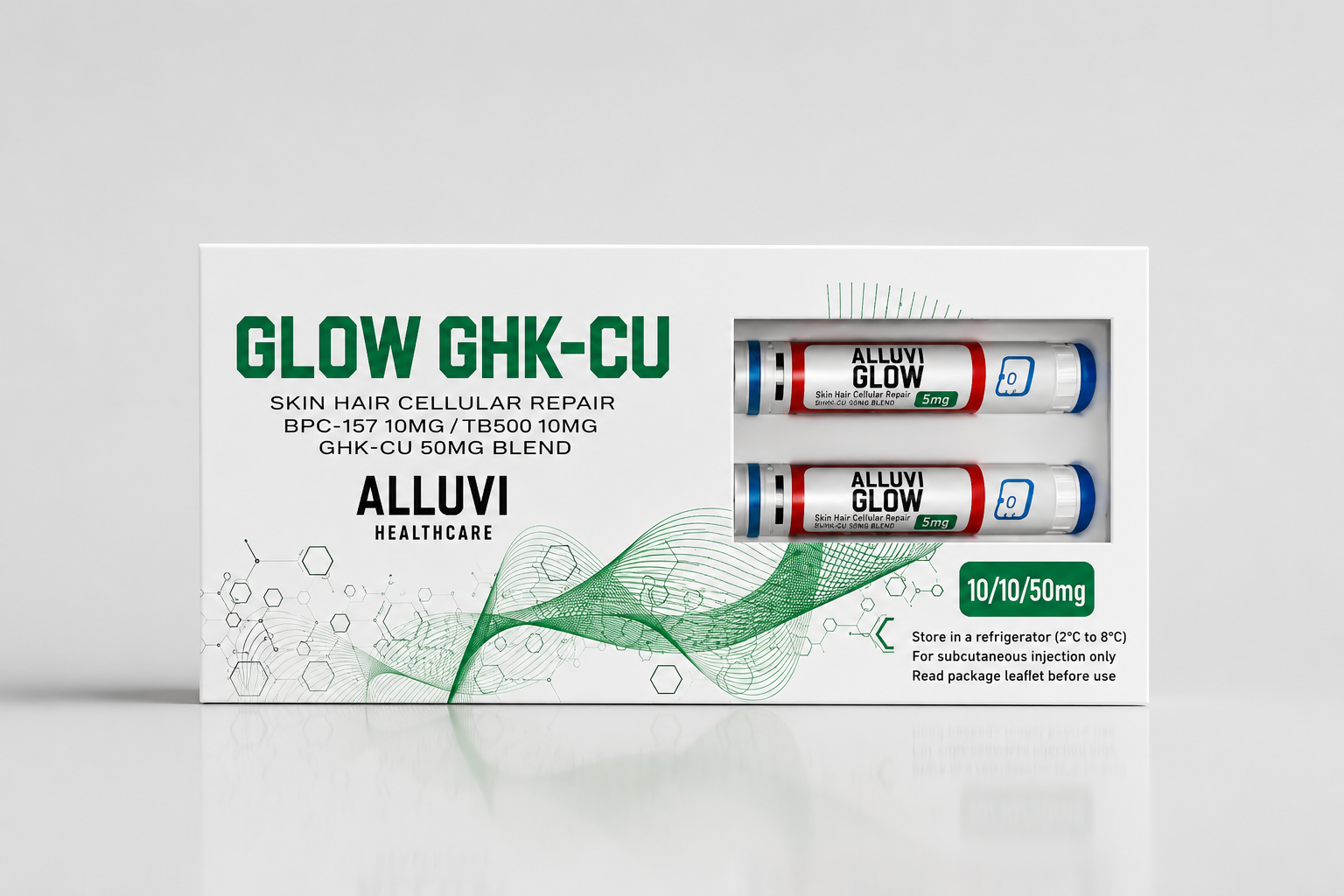
Research context for Alluvi Glow 70mg UK
Alluvi Glow 70mg UK is associated with GHK-Cu research context on the Alluvi catalogue. GHK-Cu is discussed in biochemical literature as a copper-binding peptide research subject, including questions involving coordination chemistry, molecular interactions and analytical characterisation. That background can help laboratories define scientific questions, but it does not establish the exact composition, purity, stability or performance of a separate commercial research product.
The Alluvi GHK-Cu scientific guide provides broader molecular background, while the GHK-Cu analytical testing guide focuses on analytical methods and interpretation. These educational resources are separate from the product-specific evidence required to evaluate Alluvi Glow 70mg UK.
Why the exact product identity matters
Research records should avoid vague shorthand where it could create ambiguity. A record that says only “GHK-Cu sample” may not be enough when a laboratory has several copper-peptide materials, strengths or suppliers. Recording the full name Alluvi Glow 70mg UK, the SKU and any genuine batch identifier creates a clearer chain between the catalogue, the material received and the resulting analytical data.
This exact identity also improves search clarity. Search engines can understand that this page is about a specific Alluvi research product rather than a general article about GHK-Cu. The same wording therefore supports both laboratory traceability and on-page SEO without requiring artificial keyword repetition.
Receiving and sample acceptance
When Alluvi Glow 70mg UK arrives, a laboratory can document the purchase reference, date received, package condition, product title, stated strength, SKU and any genuine batch or lot reference. If the organisation uses quarantine or acceptance procedures, those should be applied before the material enters an active research workflow.
A receiving check should compare the package with the purchase order and any supplied documentation. If the label, strength or batch information conflicts with the expected record, the laboratory should pause acceptance and request clarification. It should not change identifiers or assume that documentation from another product applies.
Understanding the stated 70mg blend strength
The 70mg figure on Alluvi Glow 70mg UK identifies the stated catalogue strength of the blend. It is not a dosing recommendation, administration instruction or statement about the quantity of every possible component unless genuine product-specific documentation provides that information. Laboratories should keep the catalogue strength separate from experimental concentration, sample-preparation variables and analytical calculation.
This distinction helps prevent a common documentation problem: treating the product title as if it were a complete analytical specification. The title identifies the commercial record. Detailed composition, where required, should come from appropriate product-specific evidence and the laboratory’s own analytical work.
Analytical planning before testing
A research team should define the question before selecting an analytical method for Alluvi Glow 70mg UK. Identity, relative composition, chromatographic profile, molecular mass, copper-related measurements, degradation, stability and biological activity are different questions. A method suitable for one purpose may not answer another.
Before testing, record the method version, controls, reference materials, system-suitability requirements, acceptance criteria and data-retention expectations. Defining those elements in advance reduces the risk of changing criteria after seeing a result. It also makes comparisons between runs more meaningful.
Chromatography and separation
Chromatographic methods may be useful for investigating Alluvi Glow 70mg UK, but interpretation depends on the column chemistry, mobile phase, gradient, temperature, detector, sample preparation and reference materials. A chromatogram should be treated as the output of a defined method rather than as universal proof of product quality.
For a blend, laboratories should consider whether the method is capable of resolving relevant components. If two signals overlap, that may limit what can be concluded about relative composition. Peak area or retention time should not automatically be converted into claims about sterility, safety, treatment effect or complete identity.
Mass spectrometry and identity questions
Mass spectrometry can contribute information relevant to molecular mass or identity when it is used appropriately. For Alluvi Glow 70mg UK, researchers should consider expected analytes, ionisation behaviour, matrix effects, calibration and reference information before interpreting a mass-related signal.
An expected signal can support a defined identity question, but it does not prove every other characteristic of a product. Depending on the research objective, complementary chromatography, spectroscopy, elemental analysis or other methods may be required.
Copper-peptide analytical context
Research involving a copper-binding peptide can include questions that differ from those asked of a non-complexed peptide. The chemical form, analytical conditions and selected method all influence interpretation. If a laboratory is specifically investigating copper-related characteristics in Alluvi Glow 70mg UK, the method should be suitable for that purpose and the report should describe exactly what was measured.
General knowledge about GHK-Cu should not be used to fill gaps in product-specific information. Scientific literature can explain molecular concepts, while actual product claims should be connected to the material and evidence being evaluated.
Evidence hierarchy for Alluvi Glow 70mg UK
| Evidence source | What it can support | What it cannot automatically prove |
|---|---|---|
| Alluvi product page | Product name, stated strength, SKU, category, price and availability | Batch purity, sterility, stability or cosmetic outcome |
| Product-specific analytical document | Measurements explicitly reported for an identified sample or batch | Characteristics the method did not measure |
| Peer-reviewed GHK-Cu literature | Scientific background and study findings | Quality of a separate commercial product |
| Internal laboratory data | Observations produced under a documented method | Claims beyond the scope of that method |
This evidence hierarchy keeps Alluvi Glow 70mg UK within a responsible research context. The product page should describe the catalogue accurately, independent literature should support broad scientific statements, and product-specific analytical claims should be tied to evidence that actually applies to the material.
Documentation and certificate review
If a certificate of analysis or analytical report is supplied for Alluvi Glow 70mg UK, laboratories should confirm that the document identifies the relevant product and batch. A certificate from another product or supplier should not be represented as if it applies. Likewise, a purity percentage, batch number or laboratory result should not be copied into the product record unless it is supported by genuine documentation.
A useful document review records the document title, date, product identifiers, batch reference and measured characteristics. If the document contains only one type of test, it should not be presented as proof of unmeasured characteristics.
Chain of custody
Chain of custody is especially useful when several people handle the same research material. For Alluvi Glow 70mg UK, records can connect the purchase, receiving entry, internal sample number, storage location, authorised transfers, analytical runs and project reports.
If the material is moved into a secondary container, the internal label should preserve the connection to the original product. A generic label that removes the exact product identity can make later review more difficult and increase the risk of mixing materials.
Storage and handling records
This product page does not invent a storage temperature, solvent, reconstitution method, preparation instruction or shelf-life value for Alluvi Glow 70mg UK. Laboratories should use genuine product-specific information and their own approved procedures. Where a required instruction is unavailable or unclear, seek clarification rather than copying conditions from a different product.
A material-history record can include the date received, storage location, access controls, transfers and relevant observations. If conditions are monitored, retain the records according to the organisation’s quality system.
Stability studies and degradation questions
Stability research requires a defined endpoint and controlled conditions. A visible change, chromatographic shift, mass change or other measured difference may be relevant, but interpretation depends on the method, time points, controls and acceptance criteria. A single observation should not be converted into a broad statement that Alluvi Glow 70mg UK is stable or unstable under every condition.
Researchers should document sample history and analytical conditions so that changes can be interpreted in context. If different time points use different methods or instruments, those changes should be noted.
Method development versus final reporting
Exploratory work can help a laboratory understand how Alluvi Glow 70mg UK behaves under different analytical conditions. However, method-development experiments should be distinguished from the procedure used for final reporting. Early runs may have changing parameters, incomplete controls or provisional acceptance criteria.
When the final method is selected, record the version and the conditions used. If the method is later changed, document what changed and why so later reviewers can determine whether differences in results reflect the sample or the analytical procedure.
Reproducibility and raw-data retention
Reproducible research depends on more than the final reported number. For Alluvi Glow 70mg UK, retain raw data, processing settings, reference information, system-suitability results, instrument identifiers and analyst records where appropriate. Another qualified person should be able to understand how the conclusion was reached.
This is particularly important for a blended research product because interpretation may depend on how individual signals are assigned or resolved. Transparent data retention allows those decisions to be reviewed.
UK research-use context
Alluvi Glow 70mg UK is presented for controlled laboratory research and scientific education only. The phrase “research use only” does not override applicable UK legal, regulatory or institutional requirements. Legal treatment can depend on the material, the way it is supplied, the claims associated with it and its intended use.
The Alluvi UK research-peptide regulation guide provides general educational context. Organisations should review current official sources and obtain qualified advice when necessary.
Independent GHK-Cu research navigation
Researchers can use PubMed results for GHK-Cu as a starting point for independent literature review. Study findings should be interpreted by considering the model, material, method, comparator, endpoint, duration and limitations.
Within Alluvi, the GHK-Cu scientific guide and GHK-Cu analytical testing guide provide additional background. These resources should not be treated as batch-specific evidence for Alluvi Glow 70mg UK.
Alluvi Glow 70mg UK receiving checklist
- Confirm the exact product name and stated 70mg blend strength.
- Record SKU 2098670500133 and the purchase reference.
- Document the date received and package condition.
- Record batch or lot information only when genuinely supplied.
- Check that any product-specific document matches the material.
- Assign an internal sample ID while preserving supplier traceability.
- Apply approved laboratory acceptance and storage procedures.
- Define the analytical question before selecting a method.
- Retain controls, reference information and raw analytical data.
- Keep final conclusions within the demonstrated scope of the method.
Frequently asked questions about Alluvi Glow 70mg UK
What is Alluvi Glow 70mg UK?
Alluvi Glow 70mg UK is a blended research catalogue product with a stated strength of 70mg, presented for controlled laboratory research and scientific education.
Does the name Glow prove a cosmetic effect?
No. “Glow” is a catalogue name. It is not evidence of a skin, hair, wellness, treatment or cosmetic result.
Is 70mg a recommended dose?
No. It identifies the stated catalogue strength and is not a dosing, administration or treatment instruction.
Is Alluvi Glow 70mg UK intended for human or veterinary use?
No. It is not intended for consumption, injection, administration, diagnosis, treatment, prevention, self-medication or personal experimentation.
Does a GHK-Cu paper validate this commercial product?
No. Independent literature can provide scientific background but does not automatically establish the identity, purity or performance of a separate commercial material.
Can one chromatogram prove the complete blend composition?
Not automatically. The conclusion depends on the method’s demonstrated separation, identification and quantification capability.
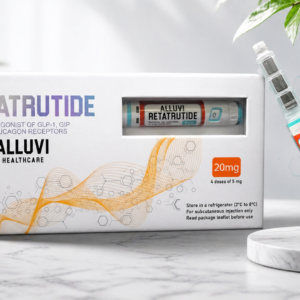
Does the product image prove identity?
No. Images support catalogue recognition and accessibility. They do not replace analytical identity testing or product-specific documentation.
What should happen if a supplied document does not match the product?
The discrepancy should be investigated before acceptance. A laboratory should not assume that a mismatched document applies.
Why are product images placed inside the long description?
They make a long technical page easier to navigate, reinforce visual product recognition and support image accessibility through descriptive alternative text. They are not scientific evidence.
SEO structure and Rank Math considerations
The main search entity on this page is Alluvi Glow 70mg UK. The exact product phrase appears naturally in the opening paragraphs, headings, body copy, FAQs and image alternative text. Related terms such as GHK-Cu research, copper peptide research, 70mg research blend and UK research product appear in context without replacing the primary product identity.
For Rank Math, useful optimisation includes an exact focus keyphrase, a concise SEO title, a relevant meta description, a readable slug, sufficient content depth, internal links, authoritative external research links, descriptive headings, image alt text and structured product data. Those elements should support the user rather than being added only to manipulate a score.
WooCommerce Product Schema and catalogue accuracy
WooCommerce and Rank Math can use the product name, price, stock state and other catalogue data to generate structured Product Schema when configured. These underlying fields should remain accurate. SEO work should not change the SKU, price, stock status or category assignment merely to alter a score.
The long description therefore focuses on product identity, documentation, research context, internal linking and accessibility while preserving the operational catalogue record for Alluvi Glow 70mg UK.
Handling unexpected analytical findings
If testing of Alluvi Glow 70mg UK produces an unexpected result, review sample identity, method suitability, controls, reference materials, system suitability, instrument performance and handling history before assigning a cause. For a blend, also consider whether component overlap, matrix effects or signal assignment could influence interpretation.
Keep the original raw data and document any repeat analysis, investigation or method change. Transparent handling of unexpected findings supports stronger scientific review and avoids presenting a convenient explanation as if it were established fact.
Audit-ready records for Alluvi Glow 70mg UK
An audit-ready file may include the purchase order, receiving record, exact product identity, genuine batch documents, internal sample ID, storage history, analytical method, run identifiers, raw data and final report. The objective is to make the history of Alluvi Glow 70mg UK understandable to a qualified reviewer who did not perform the original work.
If the same material is used in multiple projects, each project should reference the same underlying material identity while keeping project-specific methods, observations and conclusions separate.
Final research-only statement
Alluvi Glow 70mg UK is intended for controlled laboratory research and scientific education only. It is not intended for human or veterinary consumption, injection, administration, diagnosis, treatment, prevention, self-medication, cosmetic use or personal experimentation.
For approved laboratory work, preserve exact product identity, verify genuine product-specific documentation, select methods appropriate to the defined research question, retain raw data and keep conclusions within the limits of the evidence. This detailed product page is intended to improve search clarity and research usability without inventing medical, cosmetic, purity, manufacturing or testing claims.
Batch review and comparison principles
If a laboratory receives more than one batch of Alluvi Glow 70mg UK, each batch should keep its own receiving record, batch identifier, documents and analytical history. A result obtained from one batch should not automatically be assigned to another, even when the product name and stated strength are the same. Batch-to-batch comparison is most useful when the same analytical method, reference materials, instrument controls and acceptance criteria are used consistently.
Where a difference is observed, researchers should consider both material-related and method-related explanations. Changes in chromatography conditions, reference standards, software processing or instrument performance can influence results. A careful comparison therefore records the analytical context rather than presenting a difference as a product conclusion without investigation.
Procurement and inventory controls
Procurement records can strengthen traceability before the material reaches the laboratory. For Alluvi Glow 70mg UK, an order record may include the exact product title, SKU, stated strength, authorised purchaser, intended research project and date of purchase. On receipt, the laboratory can connect that commercial record to its internal sample identifier and storage record.
Inventory systems should preserve the distinction between Alluvi Glow 70mg UK and other GHK-Cu or copper-peptide research materials. This makes stock checks more reliable and reduces the chance that data, certificates or labels are attached to the wrong item.
Reviewing page information over time
The live product page can change after a purchase. Price, stock status, imagery, SEO copy and other catalogue information may be updated. For long-running projects, laboratories should therefore retain the dated purchasing and receiving information that applied to the material actually acquired rather than relying on the future state of the website.
This distinction between a live catalogue and a historical laboratory record is important for auditability. The website is useful for current product information, while the laboratory’s own dated records preserve the context of a specific transaction and sample.
Practical reproducibility summary
A reproducible record for Alluvi Glow 70mg UK connects the exact material to the exact method. At minimum, researchers should be able to identify the product, batch where available, sample ID, method version, instrument, controls, reference information, run date, analyst, raw data and final interpretation. If any of those elements change during the project, the change should be visible in the record.
That level of documentation helps separate genuine sample differences from procedural variation, supports later review and makes the product page more useful to laboratory customers seeking clear research-product information rather than unsupported promises.
Before closing a project, review whether every reported result can be traced back to the correct Alluvi Glow 70mg UK sample and method version. Confirm that supporting documents, raw files and interpretation notes are retained together. This final quality-control step improves continuity when another analyst, quality reviewer or project lead needs to understand the work later. It also keeps the product identity, supporting evidence and research conclusions aligned across purchasing, laboratory and reporting records.
Reviews
There are no reviews yet.