
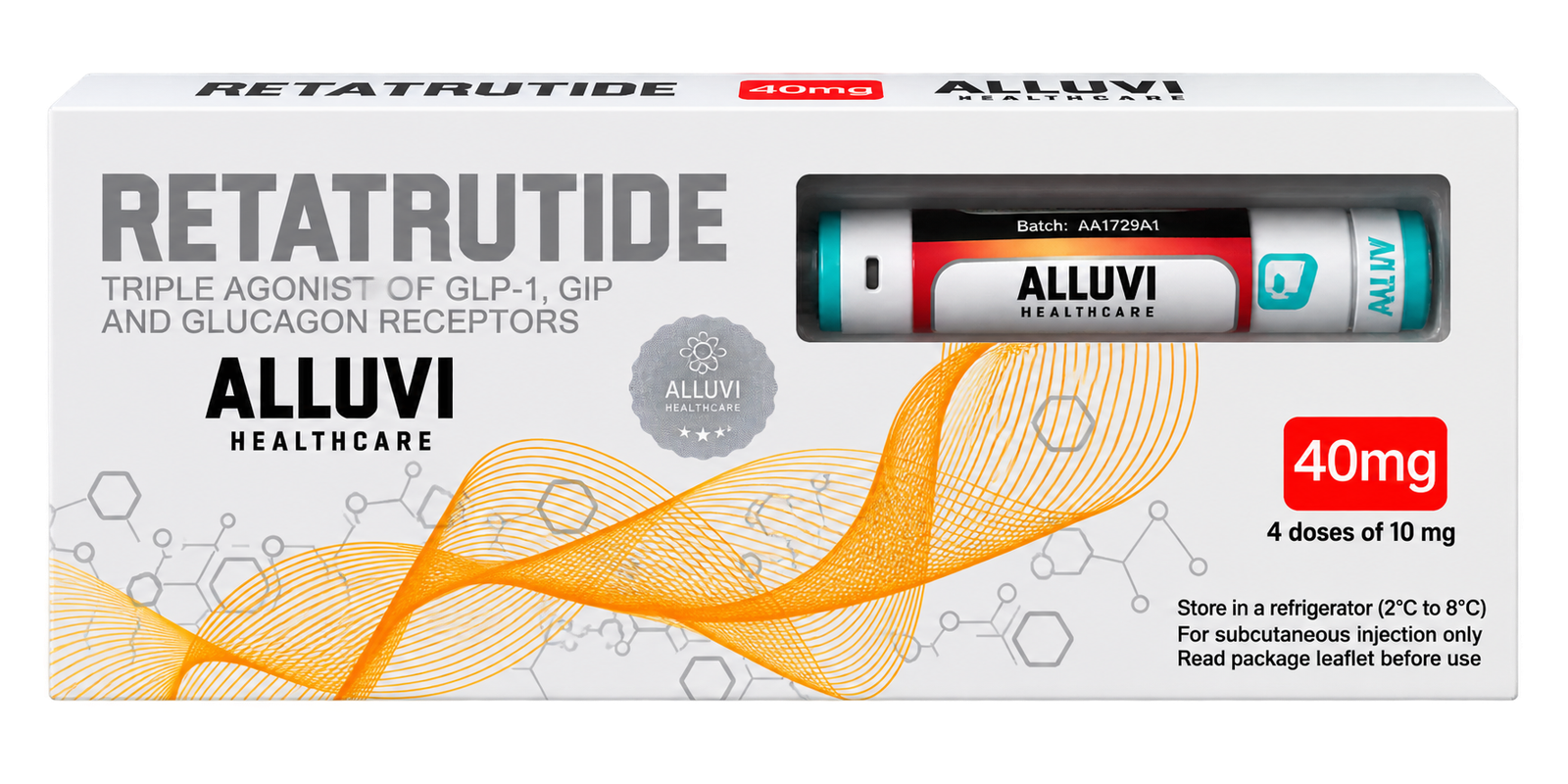
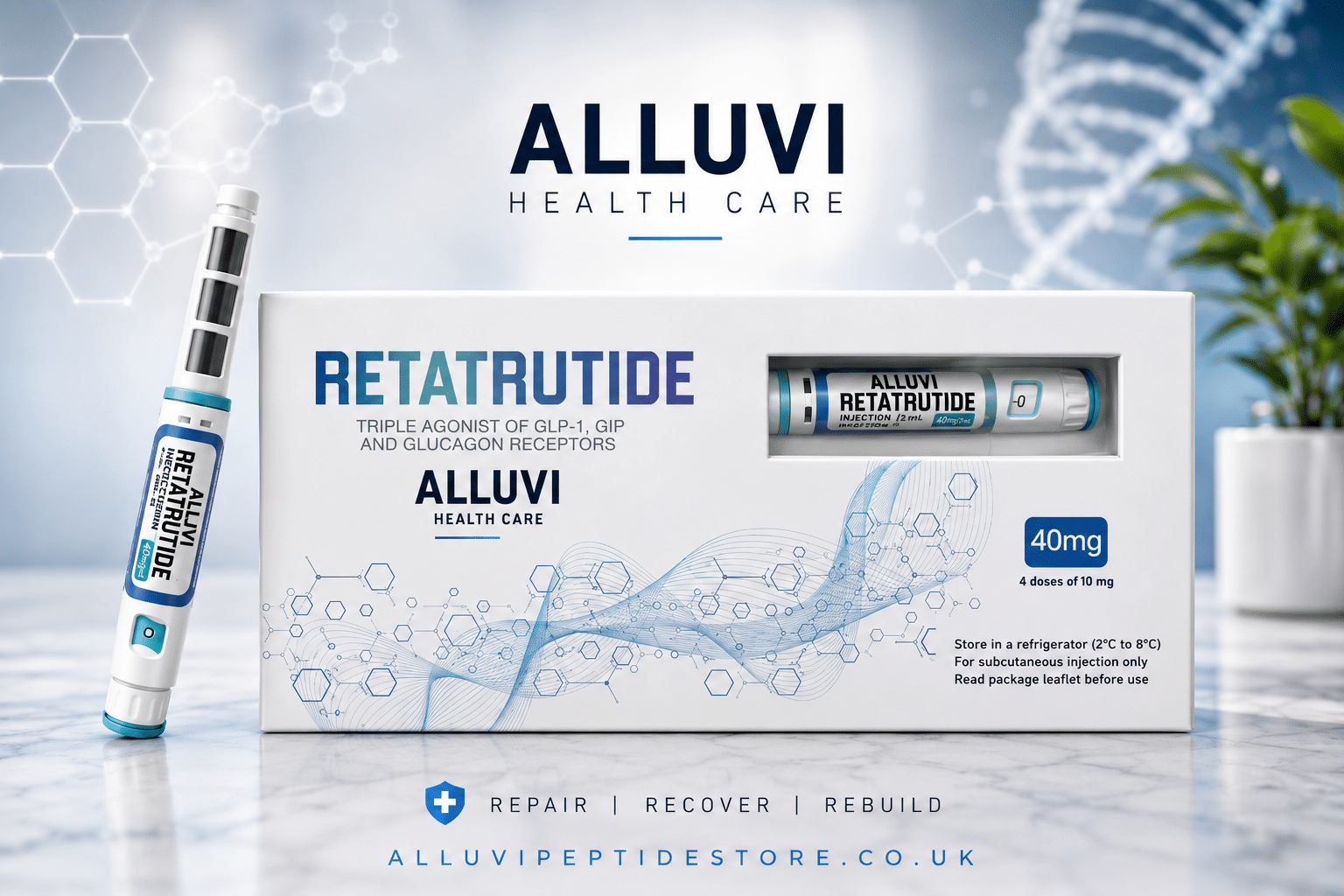
Alluvi Retatrutide 40mg UK
Retatrutide 40mg UK is a specialist research catalogue product presented by Alluvi Healthcare UK for controlled laboratory investigation, analytical research and scientific education.
Retatrutide has become a significant subject within contemporary peptide science because of its distinctive multi-receptor research profile. Also identified in scientific literature as LY3437943, the molecule is investigated in connection with glucose-dependent insulinotropic polypeptide, glucagon-like peptide-1 and glucagon receptor pathways.
The Retatrutide 40mg UK presentation provides laboratories with a clearly identified product that can be recorded alongside its SKU, stated quantity, supplier information, physical packaging and any genuine product-specific documentation supplied with the material.
This product page provides a detailed overview of the catalogue item while also explaining the wider scientific context surrounding Retatrutide research.
Alluvi Healthcare UK presents this product exclusively for research and development purposes. It is not presented as a medicine, treatment, therapeutic product or personal-use product.
Researchers interested in related materials can explore the Retatrutide Research Peptides collection or browse the full Research Peptides UK catalogue.
Product Information
| Product Detail | Information |
|---|---|
| Product | Alluvi Retatrutide 40mg UK |
| Classification | Research & Development Only |
| Stated Quantity | 40mg |
| SKU | 2012438518765 |
| Scientific Identifier | LY3437943 |
| Research Area | Retatrutide and peptide science |
| Catalogue Region | United Kingdom |
| Intended Context | Laboratory research and scientific education |
| Human Use | Not intended for human use |
| Veterinary Use | Not intended for veterinary use |
The 40mg designation forms part of the catalogue identity of Retatrutide 40mg UK. It describes the stated quantity associated with this product and should not be interpreted as a human dose, administration recommendation or treatment instruction.
Researchers should compare the physical product received with its label, SKU and supporting documentation before incorporating the material into an authorised laboratory programme.
What Is Retatrutide?
Retatrutide is an investigational peptide that has attracted considerable scientific attention because of its interaction with three receptor systems.
Scientific research describes the molecule as an agonist involving the GIP receptor, GLP-1 receptor and glucagon receptor.
This triple-receptor research profile differentiates Retatrutide from compounds designed primarily around one or two receptor pathways.
For laboratories studying Retatrutide 40mg UK, this scientific background provides useful context when reviewing receptor pharmacology, molecular signalling and peptide research.
Researchers can consult the independent PubChem Retatrutide scientific record for additional information about identifiers and scientific terminology.
General scientific information should always remain separate from product-specific claims.
A database describing Retatrutide does not automatically establish the analytical characteristics, purity, stability or other properties of an independently supplied laboratory product.
Scientific Interest in the Triple-Receptor Profile
One of the principal scientific features associated with Retatrutide is its multi-receptor profile.
Research describes activity involving GIP, GLP-1 and glucagon receptors.
This makes Retatrutide 40mg UK relevant to research environments interested in areas such as receptor pharmacology, peptide chemistry, analytical science and molecular signalling.
Potential research themes can include:
- receptor interaction;
- peptide structure;
- molecular signalling;
- analytical identity;
- chromatographic behaviour;
- mass-based characterisation;
- stability;
- comparative peptide research;
- laboratory documentation.
The appropriate research method depends on the scientific question.
A catalogue description can provide useful background, but experimental methodology should always be established by appropriately qualified researchers.
Triple-Receptor Research
Retatrutide is frequently described in the scientific literature as a triple-receptor agonist.
This terminology refers to activity involving GIP, GLP-1 and glucagon receptor systems.
The concept should not be confused with simply combining three independent research compounds.
Retatrutide is studied as a defined molecule with its own structure and pharmacological characteristics.
Researchers examining Retatrutide 40mg UK may therefore be interested in the way a single molecule interacts with several receptor pathways.
The Retatrutide Phase 2 study indexed by PubMed provides peer-reviewed scientific information relating to this receptor profile.
The publication provides valuable scientific background.
It does not, however, establish the product-specific analytical characteristics of a separately supplied laboratory material.
Current Research Status
Retatrutide remains an investigational compound.
Clinical research has progressed from earlier trials into a substantial Phase 3 development programme.
This continued development is one reason Retatrutide 40mg UK attracts interest within modern peptide research.
Scientific investigation and regulatory approval are different concepts.
An investigational molecule can be studied extensively while remaining unapproved for routine medicinal use.
Alluvi Healthcare UK therefore presents this catalogue product exclusively within an R&D context.
Researchers interested in current development information can review Lilly’s Retatrutide research information.
Maintaining a clear distinction between research and authorised medical use helps keep the product information accurate and professionally presented.
Understanding the 40mg Presentation
The stated 40mg quantity allows Retatrutide 40mg UK to be distinguished from other catalogue presentations.
Product quantity is only one part of the laboratory record.
A professional inventory system may also record:
- exact product name;
- SKU;
- supplier;
- receipt date;
- package condition;
- batch or lot reference where supplied;
- documentation received;
- internal sample identifier;
- laboratory storage location.
Clear identification becomes increasingly important when several Retatrutide products or different quantities are present within the same laboratory.
Researchers interested in another catalogue presentation can also review Alluvi Retatrutide 20mg UK.
The two products should remain separate within laboratory records.
Laboratory Traceability
Traceability is an important element of professional research.
When Retatrutide 40mg UK enters laboratory inventory, researchers should be able to connect the material with a specific product record.
This enables later review of which material was used in an experiment or analytical procedure.
Recording only a generic term such as “Retatrutide” may be insufficient when multiple products or batches are present.
A more complete record may include the product name, SKU, batch reference and receipt information.
Strong traceability supports:
- experimental reproducibility;
- product identification;
- inventory control;
- batch comparison;
- analytical documentation;
- unexpected-result investigations;
- quality-system records.
Traceability does not itself demonstrate chemical quality.
Instead, it creates the framework that connects the physical material with evidence generated during laboratory research.
Analytical Research
Analytical characterisation may form an important part of research involving Retatrutide 40mg UK.
Different laboratory techniques provide different types of information.
One project may focus on chromatographic behaviour, while another may investigate molecular identity or stability.
No single analytical method automatically answers every question about a peptide material.
Researchers should select methods according to the property they intend to investigate.
Common techniques discussed in peptide research include:
- high-performance liquid chromatography;
- mass spectrometry;
- spectroscopic approaches;
- stability analysis;
- identity testing;
- comparative analytical research.
Analytical terminology should never replace genuine evidence.
If a product page refers to a particular analytical result, that claim should be supported by appropriate product-specific documentation.
HPLC Research
High-performance liquid chromatography is widely used in peptide analytical science.
HPLC separates components within a sample according to their interactions with a chromatographic system.
A laboratory investigating Retatrutide 40mg UK may use chromatography to examine a sample’s analytical profile.
The quality and interpretation of the result depend on the method.
Important variables can include:
- sample preparation;
- analytical column;
- mobile phase;
- gradient conditions;
- flow rate;
- detector;
- reference standards;
- integration procedure;
- acceptance criteria.
An HPLC result should therefore be interpreted according to the exact method used.
A chromatographic percentage should not automatically be described as proof of every possible product characteristic.
If genuine HPLC documentation is supplied for a specific batch, the laboratory should retain the report with the corresponding product record.
Documentation belonging to another material should not automatically be applied to this one.
Mass Spectrometry
Mass spectrometry is another important technique in peptide science.
Researchers may use mass spectrometry when examining molecular-mass characteristics and aspects of identity.
For Retatrutide 40mg UK, an appropriate analytical approach may compare observed information with characteristics expected for the molecule under investigation.
Interpretation can depend on:
- sample preparation;
- ionisation technique;
- instrument configuration;
- calibration;
- mass range;
- data processing;
- expected molecular form.
A mass spectrometry result does not automatically establish every aspect of sample quality.
It may contribute to an identity assessment, but it should not automatically be interpreted as proof of complete purity, sterility, stability or biological activity.
Researchers may therefore use complementary techniques when the scientific question requires broader characterisation.
Certificates of Analysis
A Certificate of Analysis can be useful when it genuinely corresponds to the product and batch being investigated.
Researchers examining documentation supplied with Retatrutide 40mg UK should confirm that the certificate can be linked to the relevant material.
Useful information may include:
- product identity;
- batch or lot reference;
- testing date;
- analytical method;
- reported result;
- units;
- specification;
- testing organisation.
The scientific meaning of a certificate depends on what was actually tested.
For example, an HPLC result should not automatically be interpreted as proof of sterility.
Likewise, molecular-mass information should not automatically be presented as evidence of every possible sample characteristic.
Professional product evaluation requires both the reported result and the analytical method to be considered.
Batch-Specific Documentation
General scientific information about Retatrutide and product-specific analytical evidence answer different questions.
Published scientific literature may explain how the investigational molecule has been studied.
It cannot automatically demonstrate the quality characteristics of a specific Retatrutide 40mg UK batch.
Similarly, an analytical report connected to one batch should not automatically be assigned to another.
Researchers should maintain separate records for each material.
This strengthens laboratory traceability and makes research results easier to interpret later.
Research Planning
Good scientific work begins with a clearly defined research question.
A laboratory should not begin with a commercial product description and then build a conclusion around it.
Instead, the research objective should determine whether Retatrutide 40mg UK is relevant to the proposed project.
Researchers may consider:
- scientific objective;
- research model;
- literature review;
- analytical method;
- appropriate controls;
- reference standards;
- equipment requirements;
- data collection;
- acceptance criteria;
- documentation procedures.
The appropriate research conditions depend on the scientific question being investigated.
Alluvi Healthcare UK provides catalogue information and scientific background rather than experimental instructions.
Appropriate Controls
Controls help researchers interpret experimental observations.
Depending on the research method used with Retatrutide 40mg UK, appropriate comparisons may include:
- reference standards;
- blank samples;
- negative controls;
- positive controls;
- matrix controls;
- comparison materials.
The correct control depends on the experimental question.
Researchers should not assume that a control used in one published Retatrutide study is automatically appropriate for another project.
Each research environment should establish controls according to its own methodology.
Laboratory Data Recording
Accurate records improve reproducibility and scientific transparency.
When laboratory work involves Retatrutide 40mg UK, the exact product identity should remain visible in the relevant records.
A research record may include:
- product name;
- SKU;
- batch reference;
- experiment date;
- operator;
- internal sample identifier;
- instrument;
- method version;
- control information;
- observations;
- calculations;
- deviations.
Detailed records are particularly valuable when results are unexpected.
Researchers can review sample identity, analytical conditions, controls, storage history and instrument performance before reaching conclusions.
Storage Considerations
Research materials should be managed according to reliable product-specific information and established laboratory procedures.
Storage conditions for Retatrutide 40mg UK should not simply be copied from an unrelated peptide product.
Peptide stability may be influenced by several environmental factors, including:
- temperature;
- moisture;
- light;
- time;
- formulation;
- container conditions.
Where reliable product-specific storage guidance is available, it should be followed together with institutional procedures.
Laboratories may also record storage location and relevant inventory dates as part of their traceability system.
If information is unclear, researchers should obtain clarification rather than rely on assumptions.
UK Laboratory Context
Alluvi Healthcare UK presents Retatrutide 40mg UK within a UK-focused research catalogue.
Laboratories operating in the United Kingdom should consider the health, safety and institutional requirements that apply to their own research activities.
The UK Health and Safety Executive provides official information about workplace chemical safety through its COSHH guidance.
Product information can contribute to laboratory planning, but it does not replace an organisation’s own risk assessment.
The appropriate controls depend on the material, activity, workplace and research procedure.
Research-Only Position
Retatrutide 40mg UK is presented exclusively for research and development purposes.
The product is not intended for:
- human consumption;
- veterinary consumption;
- personal administration;
- self-experimentation;
- diagnosis;
- treatment;
- disease prevention;
- personal weight management;
- unsupervised use.
Scientific interest in Retatrutide does not change the research-only positioning of this catalogue item.
The product page should remain clear about this distinction.
Comparison With Tirzepatide Research
Retatrutide and Tirzepatide are distinct molecules.
They should not be treated as interchangeable research materials.
One important scientific distinction involves receptor profiles.
Retatrutide is associated with GIP, GLP-1 and glucagon receptor activity.
Tirzepatide is principally associated with GIP and GLP-1 receptor activity.
This difference can provide a basis for comparative scientific research.
A laboratory comparing Retatrutide 40mg UK with Tirzepatide-related material should maintain separate records for each compound.
Molecular identity, catalogue presentation, analytical evidence and research documentation should remain clearly distinguished.
Researchers can browse related materials through the Alluvi Research Peptides UK catalogue.
Modern Peptide Research
Modern peptide science covers a wide range of disciplines.
Research can involve:
- molecular structure;
- receptor biology;
- analytical chemistry;
- peptide stability;
- biochemical signalling;
- biotechnology;
- molecular interactions.
Retatrutide 40mg UK represents one research product within this wider scientific field.
The correct role of the material depends on the laboratory’s specific research objective.
A catalogue page should provide accurate information without predetermining scientific conclusions.
Scientific Literature
Independent scientific literature provides important context for Retatrutide research.
Researchers can review peer-reviewed publications rather than relying exclusively on commercial descriptions.
The Retatrutide Phase 2 publication on PubMed provides direct access to peer-reviewed scientific information about the molecule.
Researchers should consider study design, research material, population, comparator, endpoints and limitations before interpreting findings.
These principles are also relevant when assessing the scientific context surrounding Retatrutide 40mg UK.
A commercial product should not automatically inherit claims from an unrelated clinical study.
Scientific Source Quality
Different information sources answer different questions.
Useful sources can include:
- PubMed;
- PubChem;
- peer-reviewed scientific journals;
- clinical-trial registries;
- official regulatory sources;
- product-specific analytical documentation.
For Retatrutide 40mg UK, scientific databases can provide general compound information while product-specific documents provide information about the individual material.
These sources should complement one another rather than being treated as interchangeable.
Professional Product Evaluation
A laboratory should evaluate more than the name printed on a catalogue page.
When reviewing Retatrutide 40mg UK, researchers may consider:
- product identity;
- stated quantity;
- SKU;
- supplier details;
- packaging;
- batch information;
- product documentation;
- traceability;
- relevance to the planned research.
Professional evaluation focuses on evidence rather than marketing terminology.
Unsupported claims such as “pharmaceutical grade”, “medical grade”, “clinically proven” or an invented purity percentage should not be applied without appropriate product-specific evidence.
Comparing Research Presentations
Retatrutide may be available in more than one catalogue presentation.
Researchers comparing products should look beyond the stated quantity.
Relevant differences may include:
- catalogue identity;
- SKU;
- batch;
- documentation;
- supplier details;
- analytical information;
- package format.
The Retatrutide 40mg UK product should therefore maintain its own research record.
Researchers interested in another catalogue presentation can review Alluvi Retatrutide 20mg UK.
Product Documentation Checklist
Researchers receiving Retatrutide 40mg UK may use a basic documentation checklist:
- Confirm the full product name.
- Confirm the stated 40mg quantity.
- Record SKU 2012438518765.
- Record the supplier.
- Record the receipt date.
- Inspect the package.
- Record batch information where supplied.
- Review supporting documentation.
- Record the laboratory storage location.
- Assign an internal sample identifier where required.
- Keep analytical results with the appropriate sample record.
- Resolve discrepancies before beginning research.
This process supports a clearer product history.
Why Documentation Matters
Detailed records make later research review easier.
If an experiment involving Retatrutide 40mg UK needs to be repeated, researchers can identify the exact material associated with the original work.
If two experiments use different batches, the laboratory can determine whether that difference needs to be considered during interpretation.
Research quality depends on more than the research material itself.
Documentation, methodology, controls and transparent reporting all contribute to reliable science.
Evidence-Based Communication
Scientific evidence continues to evolve.
Retatrutide remains an active area of investigation.
Researchers working with Retatrutide 40mg UK should therefore distinguish established scientific information from developing research findings.
Professional communication should separate:
- established molecular information;
- experimental observations;
- preliminary findings;
- developing evidence;
- product-specific evidence;
- assumptions.
This produces a more accurate and credible research-product page.
Retatrutide Research Category
Alluvi Healthcare UK organises related catalogue materials by research category.
Researchers interested specifically in Retatrutide 40mg UK and other Retatrutide products can visit the Retatrutide Research Peptides collection.
For a broader catalogue view, visit Research Peptides UK.
The category structure helps visitors move between related materials without combining different product identities.
Research Education
Product pages are most useful when they remain focused on catalogue information.
Broader scientific topics can be explored separately through educational resources.
Researchers interested in peptide science, laboratory analysis and documentation can visit the Alluvi Healthcare Research Articles section.
This gives visitors researching Retatrutide 40mg UK access to additional scientific information without making the product description unnecessarily repetitive.
About Alluvi Healthcare UK
Alluvi Healthcare UK maintains a structured catalogue of laboratory research materials and scientific educational resources.
Visitors can learn more about the company’s research-focused positioning through the About Alluvi Healthcare UK page.
The site’s objective is to distinguish research-product information from unsupported medicinal claims.
That distinction is especially important for investigational molecules such as Retatrutide.
Product Enquiries
Researchers requiring information about the catalogue record, availability or documentation for Retatrutide 40mg UK can use the Alluvi Healthcare UK Contact page.
Catalogue enquiries should remain focused on research-product information.
Personal medical questions, diagnosis, treatment and administration fall outside the purpose of the research catalogue.
Frequently Asked Questions
What is Retatrutide 40mg UK?
Retatrutide 40mg UK is an Alluvi Healthcare UK research catalogue product intended for controlled laboratory investigation and scientific education. The 40mg designation identifies the stated quantity associated with this specific product.
What is Retatrutide?
Retatrutide is an investigational peptide also identified as LY3437943. Scientific literature describes activity involving GIP, GLP-1 and glucagon receptors.
Why is it described as a triple-receptor agonist?
The term refers to Retatrutide’s reported activity involving three receptor systems: GIP, GLP-1 and glucagon.
Is Retatrutide 40mg UK an approved medicine?
No. Retatrutide 40mg UK is presented exclusively as an R&D research product. Retatrutide remains an investigational molecule.
What does the 40mg designation mean?
The stated quantity identifies this particular catalogue presentation. It is not a dosing recommendation or medical instruction.
Is the product intended for human use?
No. Retatrutide 40mg UK is not intended for human or veterinary consumption, administration, treatment or self-experimentation.
Can this product be compared with the 20mg presentation?
Yes, the two listings can be compared as separate catalogue presentations. Researchers can review Alluvi Retatrutide 20mg UK separately.
What is HPLC used for?
HPLC can be used to examine the chromatographic profile of a sample under defined analytical conditions.
What can mass spectrometry show?
Mass spectrometry can provide molecular-mass information and may support aspects of identity assessment.
Should analytical documentation match the batch?
Yes. Product-specific analytical documentation should be linked to the material or batch to which it genuinely relates.
Where can researchers read independent Retatrutide information?
Researchers can review the PubChem Retatrutide record, Retatrutide research indexed by PubMed and Lilly’s Retatrutide research information.
Where can related catalogue products be found?
Visit the Retatrutide Research Peptides collection or browse the complete Research Peptides UK catalogue.
Research Use Statement
Retatrutide 40mg UK is presented exclusively for research and development purposes, controlled laboratory investigation and scientific education.
Information on this page provides catalogue details and scientific background. It does not constitute medical advice, treatment guidance, prescribing information or personal-use instructions.
Retatrutide remains an investigational molecule.
Researchers should evaluate the physical product using its label, SKU, supplier information and genuine product-specific documentation.
Independent scientific literature can provide important context but should not be treated as analytical evidence for an individual product.
For related catalogue products, visit Retatrutide Research Peptides.
For the wider Alluvi catalogue, browse Research Peptides UK.
For additional scientific educational material, visit the Alluvi Healthcare Research Articles.
Research and development use only. Not intended for human or veterinary consumption, administration, diagnosis, treatment or personal experimentation.




Reviews
There are no reviews yet.